
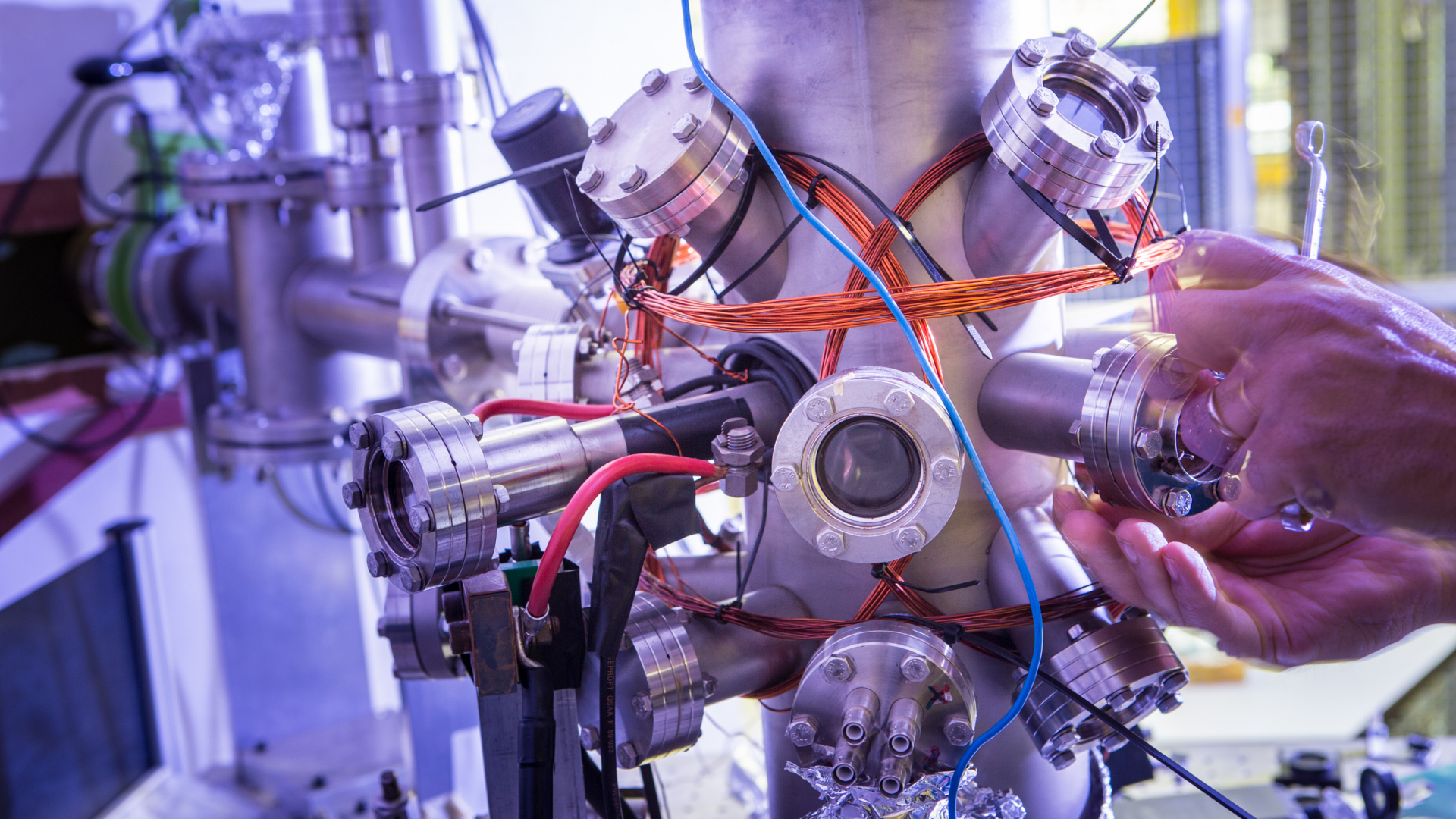
ERC grant awarded for fast, non-invasive, 3D wafer metrology
Dr. Peter Kraus has been awarded an ERC Proof of Concept grant to develop a new metrology technique using high-harmonic generation-driven extreme ultraviolet (EUV) scatterometry. This EUVISION project aims to demonstrate this as a fast, non-invasive, three-dimensional technique that can measure modern chip features at high resolution.
A measurement gap

Modern nanolithography technology can produce computer chips with features well below 20 nanometers in size. However, techniques for measuring the print quality remain limited: non-invasive methods, such as optical microscopy, do not reach this resolution of 20 nanometers; and higher-resolution methods like electron microscopy are more invasive, possibly altering the material or alignment.
As the critical dimensions of computer chip features continue to shrink, the ability to properly measure them in three dimensions becomes increasingly important.
Seeing with EUV
Funded by the European Research Council (ERC), this new project will build on recent work by PhD candidate Francesco Corazza and Dr. Manos Kechaoglou in the High-Harmonic Generation and EUV Science research group led by Peter Kraus. They recently demonstrated a novel approach that uses high-harmonic generation to produce EUV light for fast, non-invasive 3D scatterometry measurements. The results of their study were published in the journal Nature Communications.
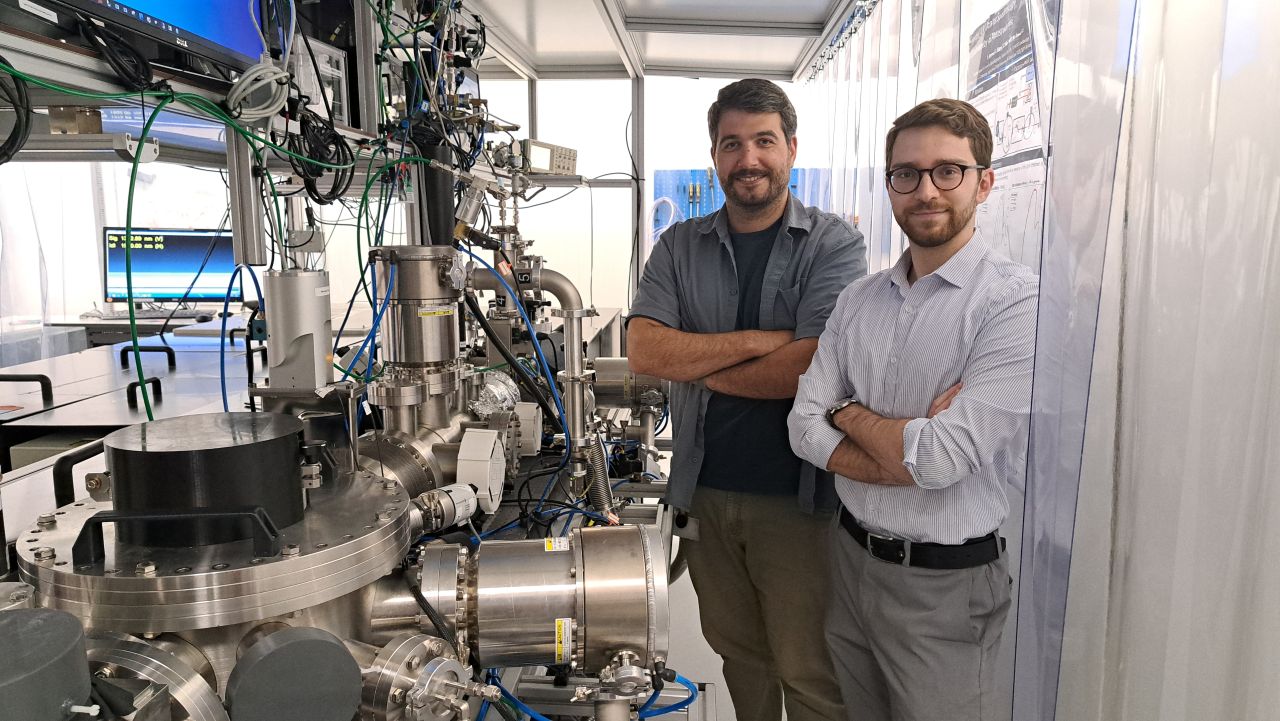
“With scatterometry, instead of making an image, we look at how the light scatters off of the structure and gather information from that,” explains Francesco. “Scatterometry is not new, but our approach using very short-wavelength light of 10-30 nanometers and only looking at the zeroth diffraction order hasn’t been done before.” Their method is faster than traditional scatterometry because it only requires the so-called zeroth order diffraction, which carries most of the scattered photons, thus offering the highest brightness.
When light gets diffracted, it is split into multiple beams at different angles – the zeroth order behaves like regular reflection or transmission, while higher orders scatter at angles that depend on the distances between features. Typically, analyzing higher order diffractions tells you more about the structures, including those distances, but that adds processing time. So, by looking at only the zeroth order, Manos and Francesco have shown that EUV scatterometry can be done on fast time scales.
A path forward
To expand on their work and develop the technique further, the group proposed the EUVISION project, which has now been awarded an ERC Proof of Concept grant.
Francesco and Manos aim to develop EUV scatterometry beyond the zeroth order to be able to access more information and create full 3D reconstructions, without sacrificing speed. Furthermore, the project will include developments to the reconstruction algorithms and demonstrating use cases for materials relevant to semiconductor manufacturing. Finally, they will explore applications of their method to atomically thin materials, where small defects can have an even larger impact on device performance.
More information
- For more information about the ERC Proof of Concept grant, visit the European Research Council website.
- If you have any questions about the EUVISION project, please contact Peter Kraus (P.Kraus@arcnl.nl).


