

Indirect EUV imaging with nanometer accuracy
ARCNL researchers have demonstrated the use of high-harmonic generation for scatterometry with nanometer accuracy. This allows them to indirectly measure nanostructures without lenses, using shorter wavelengths of light and faster processing than usual scatterometry measurements. Their study, published in the journal Nature Communications, opens the door to further developments in so-called functional semiconductor metrology.
Aspiring for accuracy
In semiconductor manufacturing, nanometer-scale structures need to be measured with extreme precision to ensure proper alignment of chip layers. At the same time, there is an ongoing challenge to increase the accuracy of measurements without making them slower. This is because the process to produce a microchip can take up to four months, so reducing the time it takes to print and measure each layer improves the overall efficiency of the manufacturing process.
One way researchers are approaching this challenge is with what is called “functional metrology,” where they reconstruct material structures and properties using physical models and algorithms, rather than imaging directly using lenses. An important part of this kind of metrology is the ability to accurately measure the physical dimensions of structural features.
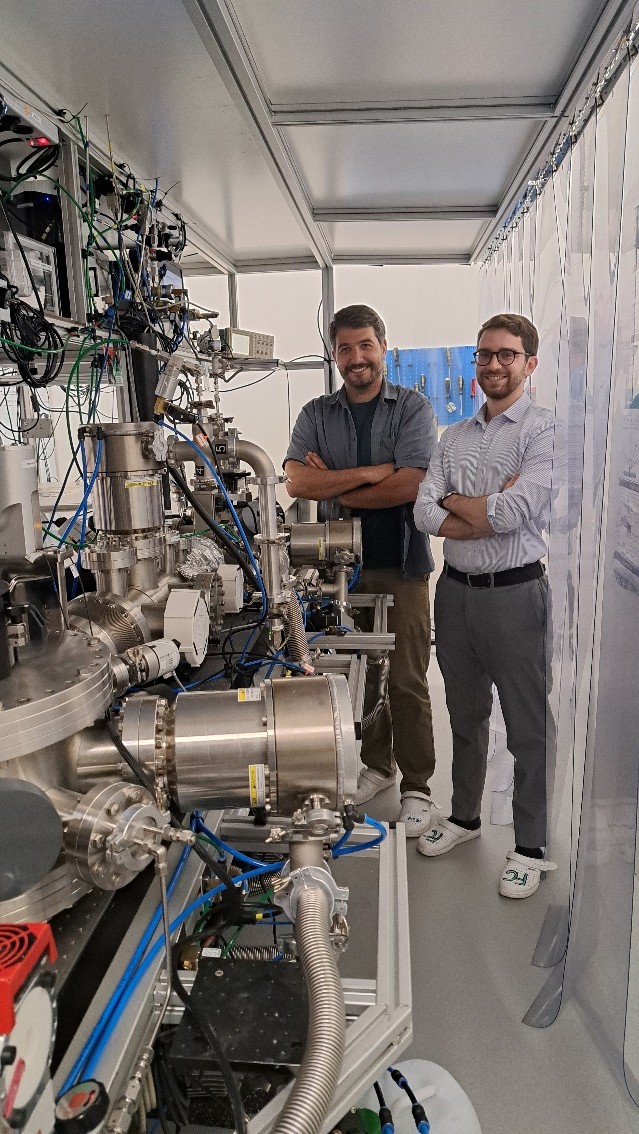
ARCNL PhD candidate Francesco Corazza and postdoctoral researcher Dr. Manos Kechaoglou decided to combine this idea with the short-wavelength extreme ultraviolet (EUV) light produced by high-harmonic generation (HHG). The result of this collaborative effort between the research groups of Dr. Peter Kraus and Dr. Roland Bliem was a high-speed metrology technique with nanometer accuracy.
Magic with scatterometry
Francesco and Manos are part of the High-Harmonic Generation and EUV Science group led by Peter Kraus at ARCNL. Their research revolves around HHG and its applications in semiconductor metrology. By producing short-wavelength EUV light, the technique can be used to probe smaller structures. However, these wavelengths are so small that they can’t be controlled using lenses.
Francesco and Manos had to use a different approach. “We used scatterometry, which is where instead of making an image, we look at how the light scatters off of the structure and gather information from that,” explains Francesco. “Scatterometry is not new, but our approach using very short-wavelength light of 10-30 nanometers and only looking at the zeroth diffraction order hasn’t been done before.”
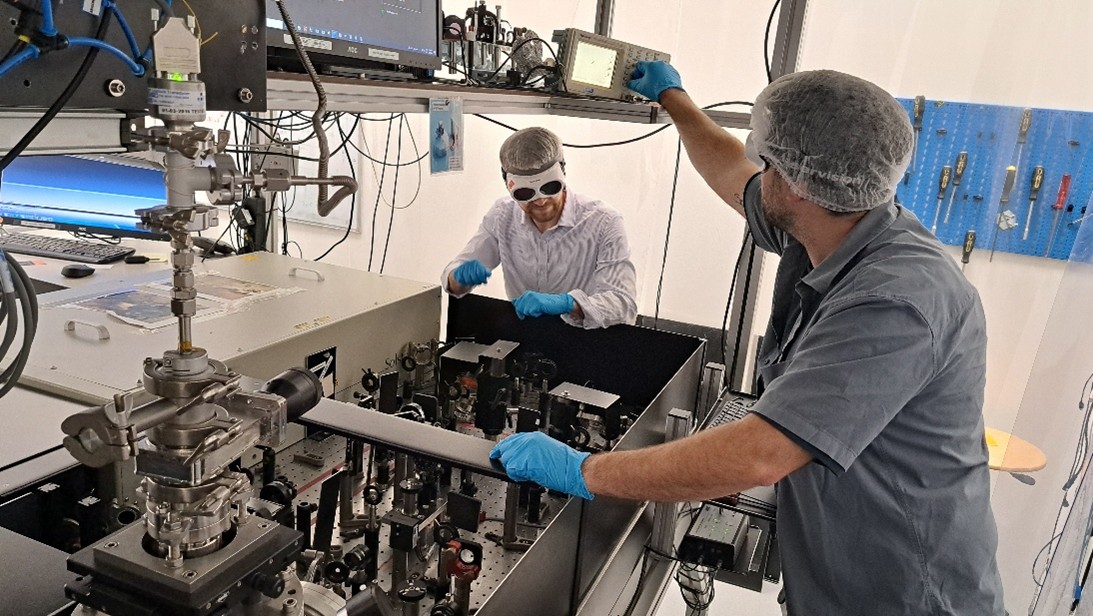
What makes the new approach even more exciting is that it’s faster than traditional scatterometry. This is because it only requires the so-called zeroth order diffraction, which carries most of scattered photons, thus offering the highest brightness.
When light gets diffracted, it is split into multiple beams at different angles – the zeroth order behaves like regular reflection or transmission, while higher orders scatter at angles that depend on the distances between features. Typically, analyzing higher order diffractions tells you more about the structures, including those distances, but that adds processing time.
Francesco and Manos took advantage of the fact that the scattered light has different wavelengths depending on the structure in question, like how light reflecting off of a CD has different colors of the rainbow because of the grooves in the disc. “If we know a bit about the kind of structure we’re looking for, we only need to look at the zeroth order and its spectrum,” says Francesco, “and then we do the magic.”
Comparing to known structures
Using zeroth-order scatterometry techniques with EUV light produced via HHG, Francesco and Manos and their colleagues were able to demonstrate nanometer accuracy by comparing to known structures. “For this method, you only need some information about what kind of structure you’re looking for,” explains Francesco. “This can be repeating patterns, for example.” The technique is especially useful for applications in semiconductor metrology, where chip layers are printed from a known design.
The team’s experiments open the door to further developments in high-speed functional metrology in semiconductor manufacturing. The results are published in the journal Nature Communications.
Contact
For more information about this research, please contact Francesco Corazza (F.Corazza@arcnl.nl) or Peter Kraus (P.Kraus@arcnl.nl).
Publication
Francesco Corazza, Emmanouil Kechaoglou, Leo Guery, Zhonghui Nie, Parikshit Phadke, Carl S. Lehmann, Roland Bliem & Peter M. Kraus, Broadband extreme ultraviolet zeroth order scatterometry for nanostructure metrology, Nature Communications (2026). DOI: 10.1038/s41467-026-73052-w


