
Laser-induced shock waves in tin droplets produce high-speed microjets
An unexpected observation led Dr. Randy Meijer and collaborators to investigate the formation of microjets in tin droplets. They found that short, consecutive, low-energy laser pulses create shock waves in the droplets, which interfere with each other and form bubbles that create jets. Published in the journal Physical Review Research, the findings provide fundamental insights into sound and bubbles at very small scales, with possible applications in medicine and propellor systems.
A curious observation

An extreme ultraviolet (EUV) light source uses one laser pulse to expand tin microdroplets into a target. Then, a second, higher energy laser pulse excites the resulting liquid tin sheet into a plasma. Using two back-to-back laser pulses in the initial droplet expansion phase may be a way to create different kinds of targets, which could be explored as a potential improvement to efficiency in EUV sources.
During his time as a postdoctoral researcher in Professor Oscar Versolato’s EUV Plasma Processes group at ARCNL, Dr. Randy Meijer was curious about multiple-pulse droplet expansion. He played around with various combinations of parameters without a clear idea of what to look for, but some time later he looked through his data and noticed something strange. Randy saw that microscopic jets were shooting out from the expanded tin droplets, making him wonder where they were coming from.
Experimental challenges
To get a better understanding of what happens at a fundamental level, Randy, Oscar and collaborators designed an experiment at lower laser-pulse energies, allowing them to investigate the phenomenon without interference from plasma formation. Then they systematically impacted droplets with laser pulse pairs of different energies and time differences.
This experiment turned out to be very challenging in practice. “The laser had to be reconfigured every time we changed the pulses,” explains Randy. “It was also difficult to maintain a constant droplet size, which drifted over time. With other experiments this isn’t as much of a problem, but these measurements were particularly sensitive to droplet size.”
To overcome this challenge, Randy and the team implemented a new laser pulse-shaping algorithm that quickly configures the laser pulse pair with the desired amplitudes and spacing. In his analysis of the data, Randy was ultimately able to correct for the effect of the drifting droplet sizes by looking at the changes over several days of experiment time.
It was also a challenge to interpret the results and form a clear picture of what was happening. “We eventually decided to look for a collaborator who could help us interpret the results through modeling,” says Randy. “We learned a lot and improved our interpretation by collaborating with Dr. Guillaume Lajoinie from the University of Twente.”
Overcoming these hurdles, the team was able to put together a cohesive report on how microjets form in laser-droplet collisions, and how they might be controlled.
Microjet-setters
After many hours in the lab and analyzing data, Randy and the team discovered that microjets emerge from tin microdroplets when irradiated with two consecutive, short, low-energy laser pulses. They saw that the speed of this jet depends in a very specific way on the time delay between the two laser pulses. By looking closely at this dependency, they were able to figure out even more details about the whole jetting process.
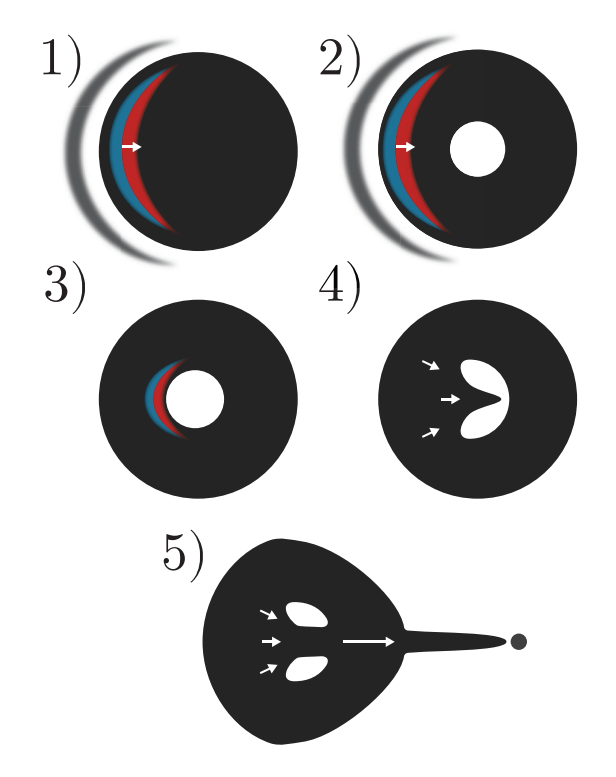
They saw that the impact of the laser pulses generated shock waves in the droplets, and that these shock waves interfere with each other to create tiny bubbles, or cavities, inside the droplet. When the bubbles collapse, microscopic jets shoot out from where these cavities have formed.
This is similar to what happens in sonicators for dental cleaning or on the blades of ship propellors. Randy explains: “Sonicators create sound waves that bounce around in the water bath and lead to cavities forming on the surface of the object in the bath. These cavities then collapse, or ‘pop,’ and generate shock waves and a jet, which erode and clean the object. For propellors, their own movement causes cavities to form on their surfaces. When these cavities pop, the same thing happens. The resulting shocks and jet erode the surface.” While these two examples and the experiment each involve different mechanisms of bubble formation, the collapse of all their bubbles generates jets.
Possible applications
What is most exciting about these findings is that these microjets are part of a fundamental phenomenon of fluid mechanics, making these observations relevant not just in the case of tin droplets, but other fields as well. “For EUV sources it can help with developing a more efficient/optimal target-preparation process,” explains Randy. “Meanwhile in medicine, needle-free injection and sonoporation – using ultrasound to create temporary pores in cell membranes for targeted therapies – are two topics that are strongly related to this work. Lastly, it could also contribute to efforts aimed to minimizing erosion in systems such as ship propellors.”
The results of this study are published in the journal Physical Review Research.
Contact
If you have questions about this research, please contact Oscar Versolato (O.Versolato@arcnl.nl).
Publication
Randy A. Meijer, Guillaume Lajoinie, Bo Liu, Stefan Witte, Oscar O. Versolato, Controlled Interference of Laser-Induced Shock Waves in Microdroplet Jetting, Physical Review Research 8, 023287 (2026). DOI: 10.1103/8ltx-t2xs


