
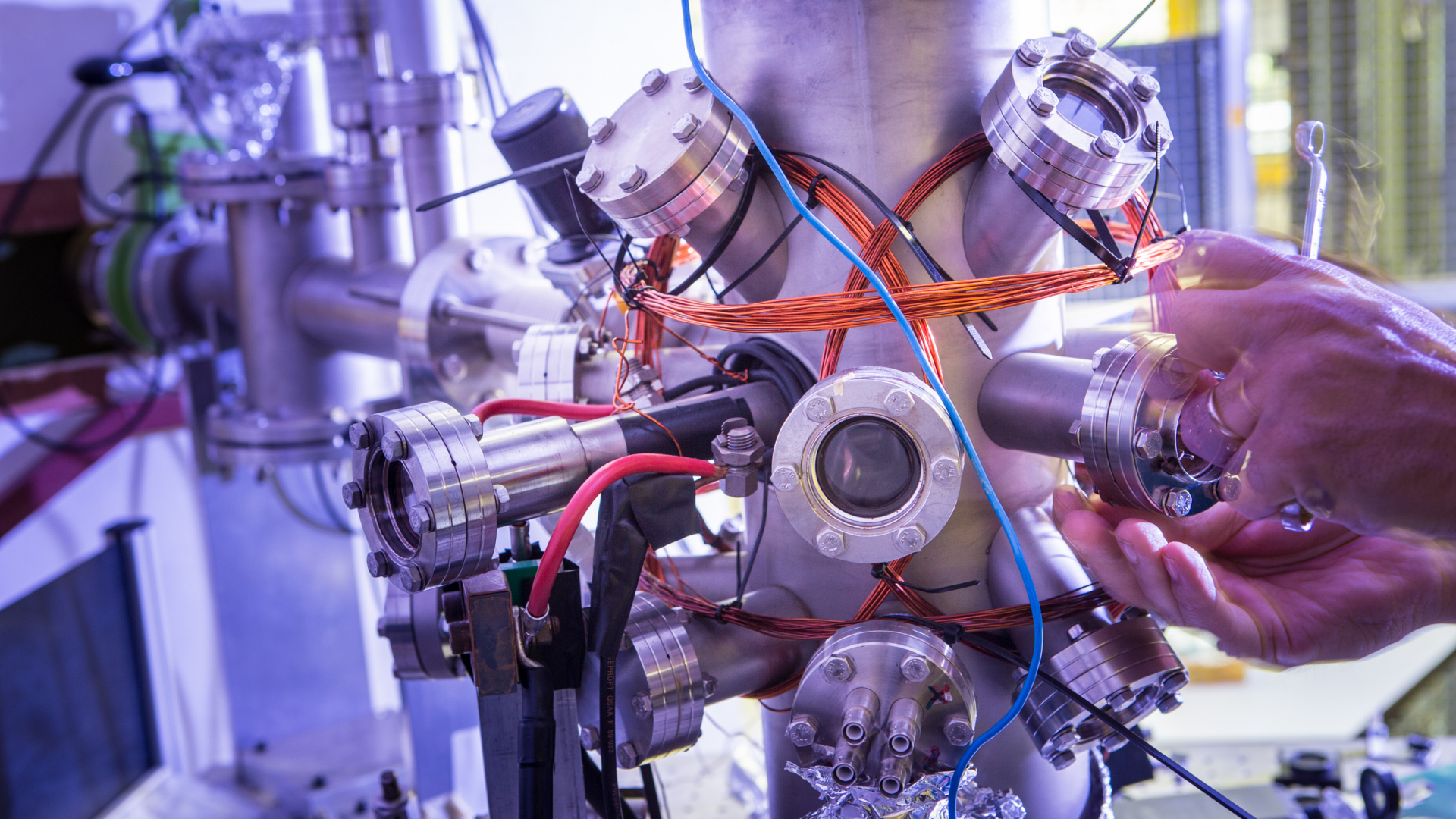
Phase and intensity closely linked in solid high-harmonic generation process
Researchers at ARCNL and the Madrid Institute of Materials Sciences have achieved a breakthrough in precisely measuring and understanding a fundamental property of the high-harmonic generation (HHG) process in solids: a strong dependence of the emitted harmonic phase on the driving laser intensity. The results, published in the journal Science Advances, can improve the development of efficient solid HHG light sources and assist in ultra precise optical characterization of materials for electronics and nanotechnologies.
Out-of-sync harmonics
High-harmonic generation (HHG) in solids is a technique that transforms intense laser pulses interacting with a solid material into bursts of higher-frequency light – including extreme ultraviolet (EUV) light – known as harmonics. It can be used to create compact, coherent short-wavelength EUV light sources, but also to probe the structure and dynamics of materials at the nanoscale by studying the emitted harmonics.
However, oftentimes the EUV light that comes out is not perfectly in sync with the input laser light, and different parts of the output beam are not even in sync with each other. This so-called phase difference causes the EUV beam to be less intense and diverge more than it would otherwise. Why does this matter? The phase of light determines how well it can be focused and controlled – key factors for applications ranging from high-resolution imaging to next-generation electronics and quantum technologies.
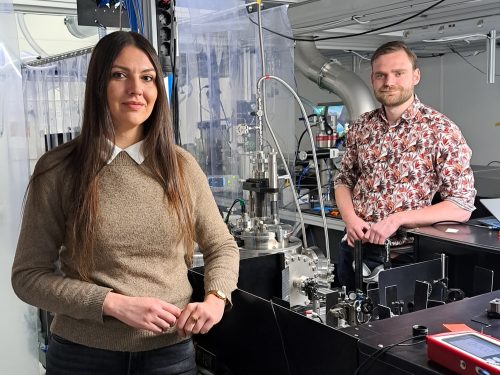
While it has been known that this phase depends on the driving laser intensity, precisely measuring it and linking it to a complete theoretical framework had never been achieved for HHG in solids – until now.
Nataliia Kuzkova and Pieter van Essen, together with colleagues in the HHG and EUV Science group led by Peter Kraus, set out to do exactly that.
Attosecond interferometry unlocks the phase
Nataliia and Pieter wanted to map how the phase of the emitted harmonics from the solid changes while varying the input laser intensity with precise timing – on the attosecond scale (billionths of a billionth of a second). “The technical challenge was being able to measure this phase,” says Nataliia, “but we succeeded by using an ultrastable interferometric approach, where we analyze the interference patterns produced when two EUV light waves are combined, with attosecond-level precision.”
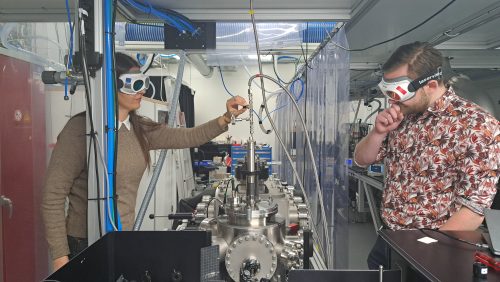
With complex numerical simulations and analytical modeling conducted in collaboration with researchers at the Madrid Institute of Materials Sciences, the team was able to distill their experimental results into a comprehensive physical explanation. They fully confirmed the experimental findings and quantified how the phase of the emitted EUV light depends on the input laser intensity in the solid material. “Say you’re pushing your friend on a swing. You can think of the phase as being where in the swinging trajectory they are at any given time,” explains Pieter. “Our results are like if that phase changed depending on how hard you push them, rather than just your timing.”
This also explains why different parts of the output harmonic beam fall out of sync with each other. A laser beam profile is not uniform in intensity – it is typically strongest at the center and gradually fades towards the edges. It is now clear that this effect can lead to a non-uniform phase profile in the output beam, resulting in a diverging EUV beam and lower harmonic intensity, making it more difficult to measure and control. However, understanding the origin and magnitude of this effect allows researchers to account for it in their experiments and analyses.
Outlook
The results of the study are published in the journal Science Advances. While a direct application of these findings is still forthcoming, they pave the way for controlling the harmonic wavefront and improving the ability to focus EUV beams in next-generation technologies: from ultra-precise microscopes that can image nanoscale structures, to compact light sources for semiconductor chip manufacturing.
Contact
For more information about this work, please contact Nataliia Kuzkova (N.Kuzkova@arcnl.nl).
Publication
Nataliia Kuzkova, Pieter J. van Essen, Roy van der Linden, Brian de Keijzer, Rui E. F. Silva, Álvaro Jiménez Galán, and Peter M. Kraus, Attosecond high-harmonic interferometry probes orbital- and band-dependent dipole phase in magnesium oxide, Science Advances 12,eaeb4109 (2026). DOI: 10.1126/sciadv.aeb4109


