
Two parameters define how tin droplets deform
To create extreme ultraviolet (EUV) light, droplets of liquid tin are hit with a laser at very high power. But what happens at lower energies? In a new paper published in the Journal of Fluid Mechanics, ARCNL postdoctoral researcher Mikheil Kharbedia and colleagues explored the full spectrum of low-energy droplet deformation. They found that droplets only deform in certain shapes which depend on just two parameters: the laser energy and how broad the resulting force is on the droplet’s surface.
Low-energy experiments
When a drop of rain hits the ground, the collision causes the droplet to splash. A similar splash occurs when a liquid tin droplet is hit with a high-energy laser pulse – there is a pressure exerted by the laser which deforms the droplet. In extreme ultraviolet (EUV) light generation, this interaction occurs at very high energies. Studies of this process look at the droplet deformation from every angle.
However, not much is known about what happens to the droplet at lower laser energies. Understanding the physics of low-energy droplet deformation can contribute to a more complete picture of the complex interactions in real EUV sources. More than that, it’s an interesting fundamental question that can be applied in fluid mechanics more generally.
ARCNL postdoctoral researcher Mikheil Kharbedia set out to explore a broader range within the energy spectrum of this laser-droplet interaction, together with fellow EUV Plasma Processes group members Hugo França, Karl Schubert and Dion Engels, group leader Oscar Versolato and collaborator Maziyar Jalaal (University of Amsterdam). The results of their study, now published in the Journal of Fluid Mechanics, reveal a beautiful simplicity in complex fluid dynamics.
A two-dimensional description
After exhaustive experimentation and work with simulations and theoretical modeling, Mikheil and the team were able to show that droplet deformations take specific shapes, or “phases,” and that which phase appears depends on only two parameters. “The energy of the laser and the angular distribution of the surface pressure are the only two parameters that define droplet deformation morphology,” says Mikheil. “It’s very exciting to be able to express such complex dynamics in terms of only two variables.”
Usually, in addition to these two parameters, other factors that are expected to play a role include, for example, the length of the laser pulse, the size of the droplet, and the droplet’s surface tension. Mikheil’s project resulted in a two-dimensional diagram that fully illustrates the relationship between the two parameters, laser energy and pressure distribution, and the deformation phases they induce.
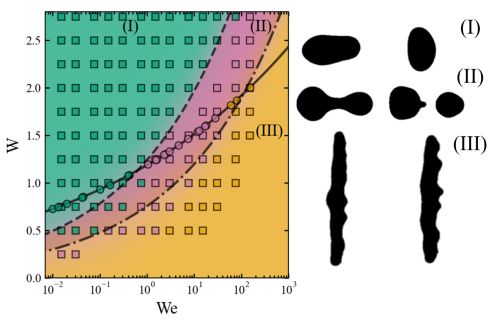
The hardest part was drawing the line between phases. “Finding the scaling laws – that is, the mathematical equations that explain the behavior at the boundaries – took a lot of brainstorming with the group,” shares Mikheil. “We had to consider many different mechanics of droplet deformation, but in the end we were able to get a complete picture, and I’m proud of what we accomplished together.”
Not just lasers
What’s most exciting about this is its universal applicability in fluid mechanics. “What we found is not exclusive to laser-tin interactions,” says Mikheil. “In the case of rain on the ground, the speed of the raindrop is equivalent to laser energy, and the shape of the ground gives the pressure distribution – these two things determine what happens to the droplet.”
With further study, such a universal description could be useful in applications ranging from printing on hydrophobic surfaces to needle-less medical injections using high-speed droplets.
Contact
For more information about this research, please contact Mikheil Kharbedia (M.Kharbedia@arcnl.nl).
Publication
Mikheil Kharbedia, Hugo França, H. Karl Schubert, Dion J. Engels, Maziyar Jalaal, Oscar O. Versolato, Laser-driven droplet deformation at low Weber numbers, Journal of Fluid Mechanics 1034, A26 (2026). DOI: 10.1017/jfm.2026.11470


