
Professor Oscar Versolato gives inaugural lecture at Vrije Universiteit Amsterdam
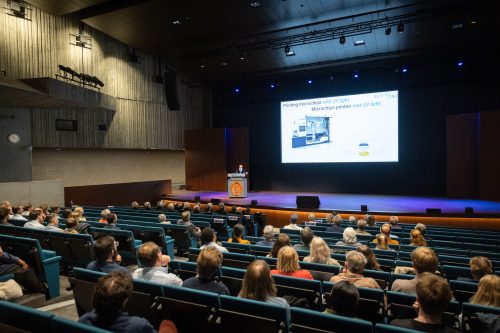
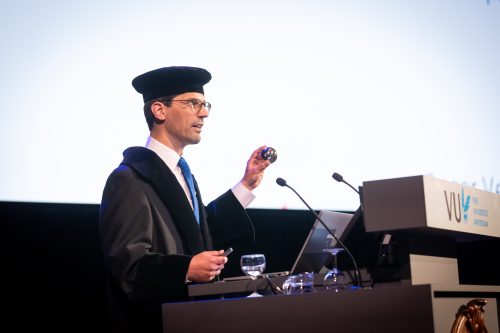
On May 7, ARCNL group leader Oscar Versolato gave his inaugural lecture to commemorate his appointment as Professor of EUV plasma processes at Vrije Universiteit Amsterdam (VU Amsterdam). The lecture was titled, “Turning metal into light: the story of EUV plasma.” In the lecture, Oscar discussed the magic of a droplet of tin, and how it gives rise to the light that creates patterns on the microchips that power the modern world.
A pillar of the ARCNL community
Oscar Versolato has been working on research on extreme ultraviolet (EUV) light sources at ARCNL since 2014. Since 2019 he is a tenured group leader of the EUV Plasma Processes group at ARCNL and was Associate Professor at VU Amsterdam until his appointment to Full Professor in February of this year. He is the head of the Source department at ARCNL.
Turning metal into light
Oscar’s research focuses on the process of creating EUV light from microscopic molten tin droplets. “My research actually begins with one simple droplet of tin. When this droplet, smaller than a human hair, is hit by powerful lasers, it eventually produces EUV light. This light is essential for creating the tiniest patterns on microchips. Doesn’t that make tin magicalays Oscar in an interview with VU Amsterdam.
By understanding this process at a fundamental level, researchers can use this knowledge to help develop next-generation EUV light sources for computer chip manufacturing.
From one droplet to the future of chip technology
While inspired by applications in the semiconductor industry, Oscar’s research has always been driven by curiosity. “It took us years to understand where the light from that one droplet of tin came from. This may sound boring to many people, but the research has so much depth, and there is still so much to discover.”
In the coming years, the professor hopes to gain an even better understanding of how laser light, tin and plasma interact: how the droplet deforms, which particles emit the desired EUV light, and how this process can be made more efficient for the chip technology of the future.
You can read the rest of the interview on the VU Amsterdam website: https://vu.nl/en/news/2026/everything-is-hidden-in-that-one-droplet-of-tin


