

Tiny salt crystals reduce friction and wear on silicon surfaces
During his MSc project, ARCNL PhD candidate Tijn Vernooij discovered that calcium sulfate, a widely used material, could be used in the form of thin nanocrystals to reduce friction between silicon surfaces. Now published in the journal Wear, his study forms the starting point for developing longer-lasting precision positioners for semiconductor manufacturing processes.
New use for a common substance
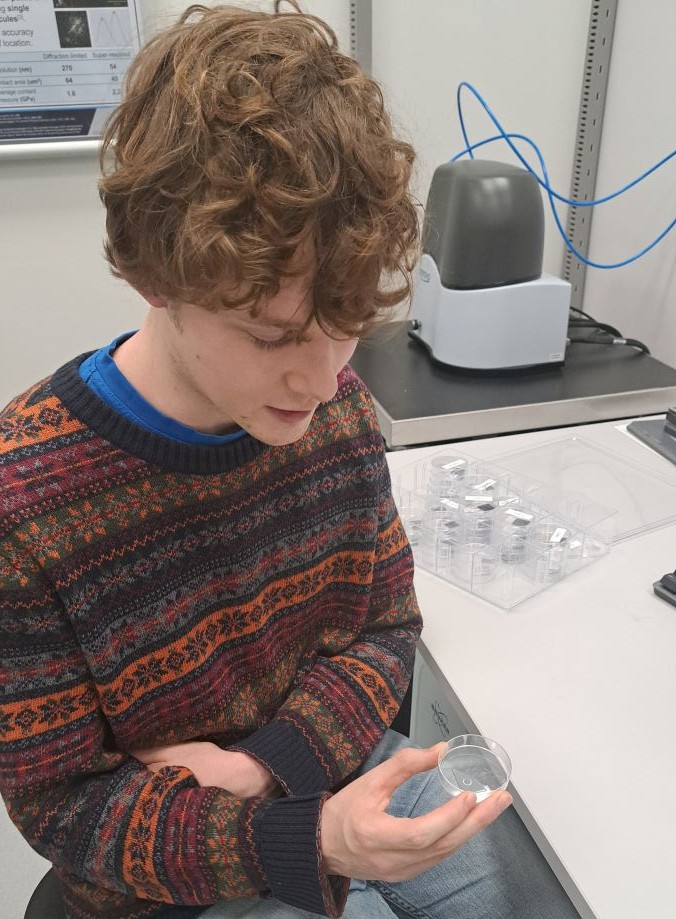
In modern chip manufacturing, silicon wafers must be positioned with extreme accuracy, sometimes down to just a few nanometers. But even when surfaces look perfectly smooth, friction and tiny amounts of wear can slowly cause small deformations. Over time, this can reduce positioning accuracy.
In a recent publication in the journal Wear, researchers at ARCNL and the University of Amsterdam demonstrate a promising way to tackle this problem: a thin layer of microscopic calcium sulfate crystals deposited on silicon. Calcium sulfate is a widely used material, found for example in drywall and medical casts.
The team shows that this nanocrystal coating can reduce friction and wear between sliding silicon surfaces, potentially helping precision systems stay accurate for longer.
A “marble-like” effect at the nanoscale
To understand the idea, first author Tijn Vernooij compares it to a simple, albeit unlikely, situation: “Imagine a patch of marbles lying on an asphalt road. When you drive on top of the marbles, the wheels will lose friction and grip with the road below, and your car will slide over the surface with little resistance. The nanocrystals function a bit like the marbles on a smaller scale.”
Just like marbles can reduce grip between a tire and the road, these nanocrystals act as tiny particles between two larger sliding surfaces, lowering friction and helping to prevent damage.
A simple way to deposit nanocrystals on silicon
Tijn developed and tested a straightforward method to coat silicon with a thin crystal layer. The process involves placing a droplet containing the dissolved calcium sulfate crystals onto the silicon. As the droplet evaporates, it leaves behind a smooth and consistent layer of nanocrystals.
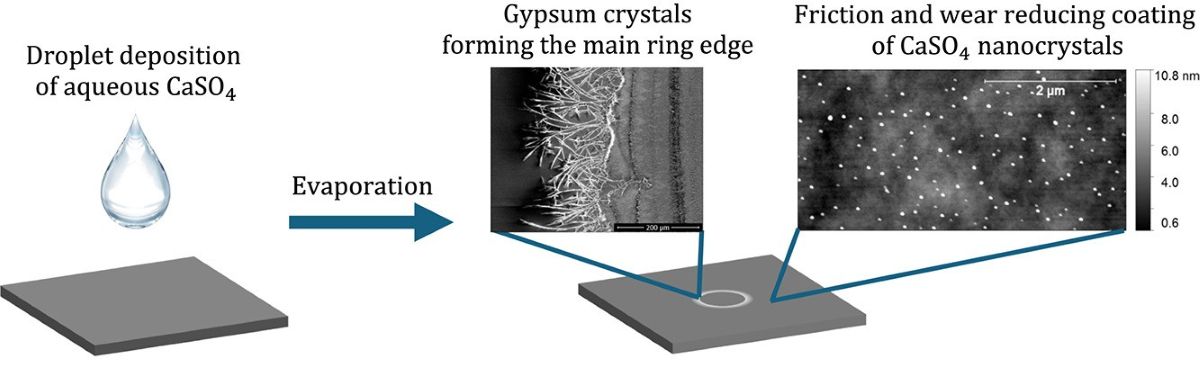
Tijn then investigated what happens when two silicon surfaces slide against each other with these nanocrystals present. He found that the coating reduces the friction coefficient during sliding, which in turn reduces wear at the interface.
Longer-lasting high-precision technology
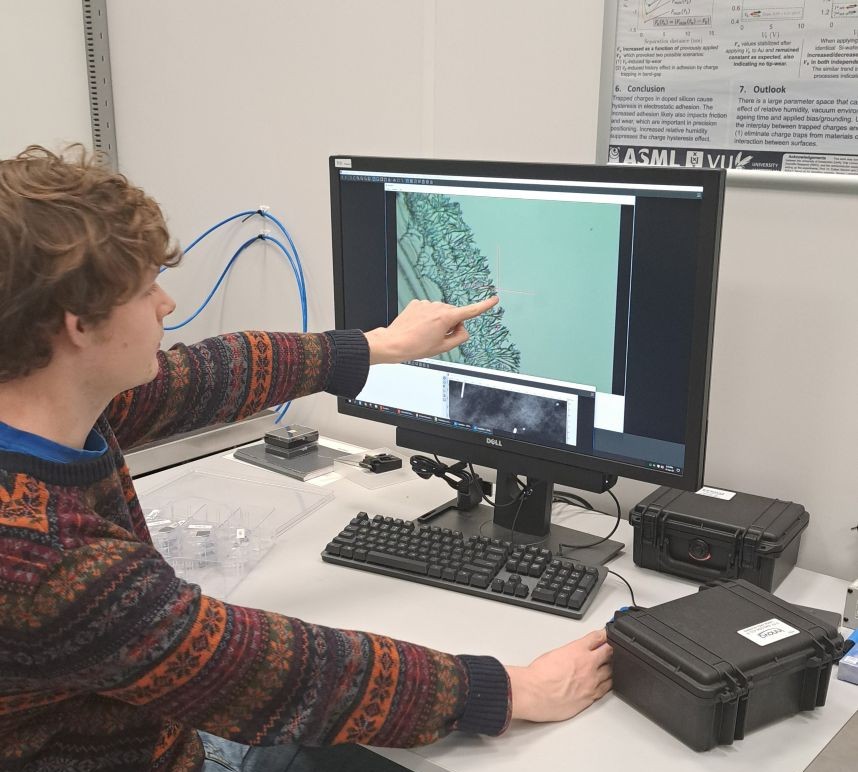
The main motivation for this work is the need for reliable, long-lasting precision positioning, especially in the semiconductor industry. “Silicon wafers need to be positioned extremely precisely in modern chip manufacturing processes,” Tijn explains, “so even a tiny amount of friction and wear between a wafer and the surface it is laying on, can cause small deformations that reduce positioning accuracy.” Nanocrystal coatings could help reduce those effects and keep systems stable for longer.
Improving wear resistance can also contribute to sustainability. Today, surfaces used to hold wafers may need frequent replacement because even tiny amounts of wear can make them too inaccurate. Solutions such as nanocrystal coatings could help make positioners last longer, reducing waste and improving sustainability in high-tech manufacturing.
Tijn also points out that the method is not necessarily restricted to use in the semiconductor industry and could potentially be adapted to deposit other materials on larger scales. “Friction-reducing nanocrystals might also help increase the lifetime and reduce the energy consumption of machines with moving parts,” he says.
From MSc thesis to PhD research
Tijn carried out this study as the final project of his MSc in Physics at the University of Amsterdam, in the Contact Dynamics research group of Bart Weber at ARCNL. He prepared the samples at the University of Amsterdam, where Professor Noushine Shahidzadeh, an expert in salt crystallization, taught the team how to prepare nanocrystal deposits. Tijn then performed detailed measurements at ARCNL using an atomic force microscope. Tijn: “I liked that with this research, we managed to make a connection between two quite different fields – salt crystallization and making precision surfaces for high-accuracy positioning.” The results are published in the journal Wear.
After completing the MSc project, Tijn continued in the research group as a PhD candidate, where he is now looking into the role of electrostatics in friction and wear. A new MSc student is following up on Tijn’s work on nanocrystals, investigating whether the results of this project can be scaled up to larger interfaces.
Contact
For more information about this work, contact Tijn Vernooij via email.
Publication
Tijn Vernooij, H. Tunç Çiftçi, Noushine Shahidzadeh, & Bart Weber, Amorphous CaSO4 nanocrystal deposits for friction and wear reduction at silicon interfaces, Wear 586, 206457 (2026).


