
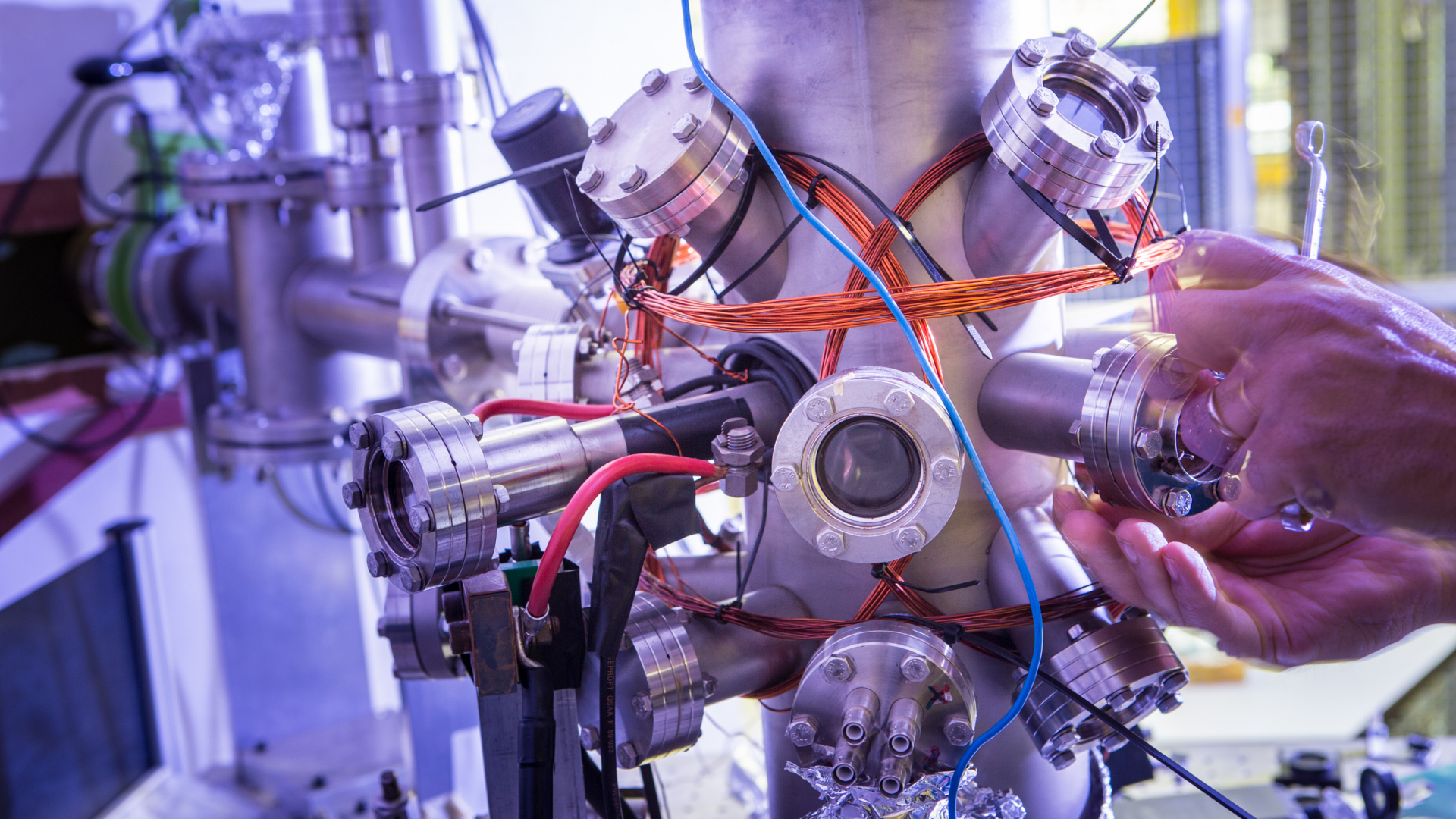
Solving the tin plasma puzzle
Much of the energy consumption in nanolithography machines comes from the laser used in the extreme ultraviolet (EUV) light source. ARCNL researchers have been developing techniques using an alternative type of laser that uses less energy than the industry standard. Now, in a study published in the journal Nature Communications Physics, they reveal a complete description of where the energy of this laser goes in tin plasma and how it could be promising for next-generation EUV sources.
A source of inspiration (and EUV light)
The extreme ultraviolet (EUV) light used to print the world’s smallest computer chips is made by using a high-powered laser to turn liquid tin into a plasma. The tin plasma then emits EUV light. However, that EUV only makes up a small percentage of the energy that comes out of the plasma, with the rest released as other wavelengths of light and tin ions.
Given that the laser that drives this process accounts for much of the energy consumption in nanolithography processes, being able to generate EUV using a more energy-efficient drive laser could be a significant step in improving the energy efficiency overall. ARCNL researchers in the Source department have been working on this for several years, using a solid-state laser with a wavelength of 2 micrometers. By comparison, the industry standard of a so-called carbon dioxide gas laser, which requires more electricity than a laser using a solid medium, has a wavelength of 10.6 micrometers.
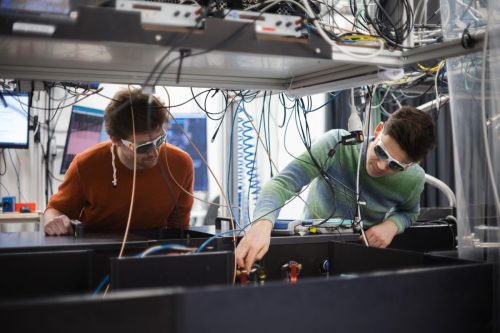
Over the years, they have developed various methods of measuring the light and ions that come of the tin plasma, and they’ve managed to show that the 2-micron laser can indeed be used to make EUV. Focused on producing EUV with this laser in the first place, their previous studies didn’t give a full picture of the plasma with this new laser wavelength. Studying how the output light and ions change with laser intensity, for example, would give more insight into how the plasma forms.
However, their work up to now has given them all the pieces they needed to fully map out how the laser energy is partitioned between output channels: EUV, other light, and tin ions. Their recent study published in the journal Nature Communications Physics builds on years of developments to reveal the complete energy partitioning for a 2-micron laser driven plasma. Their results pave the way for future engineering work to develop more energy-efficient EUV light sources.
Like a complicated light bulb
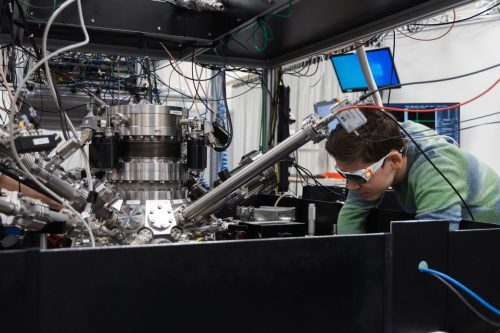
Similar to an incandescent light bulb that creates light by heating a wire, an EUV source creates light by heating tin. “A light bulb has a certain energy efficiency. Some of that energy becomes light and some becomes heat,” describes first co-author Felix Kohlmeier, PhD candidate in the EUV Plasma Processes group at ARCNL. “The goal of our study was to measure this for tin plasma – how much of the laser energy put in becomes EUV, and how much becomes other light or tin ions?”
Getting reliable measurements at different input intensities was no small feat. “We have a very big setup with many components, and all of them have to work together,” says Felix. “Every time you change a parameter, you might suddenly find out that the experiment is sensitive to something you hadn’t accounted for before. So, conducting this study led us to improve all of the tools we developed over the years, one by one.”
“The culmination of 10 years of work”
With teamwork and patience, the team showed what 2-micron laser-driven tin plasmas are made of, at a wide range of laser intensities. About 4% of what comes out is EUV, while the vast majority of the plasma energy – around 70% – is released as other wavelengths of light ranging from 5-250 nanometers. The rest is released in the form of tin ions, but this fraction decreases at higher laser intensities – a key insight in finding pathways to optimize plasma for industrial application.
What the team finds most exciting is the fact that this is the first time such a complete energy description for tin plasma with 2-micron lasers has been published. “This is the culmination of 10 years of experimental work at ARCNL,” says principal investigator Professor Oscar Versolato, leader of the EUV Plasma Processes group.
The results of the project provide a benchmark for plasma light source development, paving the way for engineering research necessary to put it into practice in next-generation nanolithography machines. “Knowing how to make EUV light is not enough to make a machine to make EUV light,” says Felix. “There is still engineering work to be done – but this is the piece of the puzzle needed to be able to start that work.”
Contact
For more information about this research, please contact Professor Oscar Versolato.
Publication
D. J. Engels, F. M. Kohlmeier, Y. Mostafa, E. J. Salumbides, B. W. Slotema, R. Hoekstra, J. Sheil, W. Ubachs & O. O. Versolato. Full energy partitioning in 2 μm wavelength laser driven extreme ultraviolet sources. Nature Communications Physics 9, 321 (2026). DOI: 10.1038/s42005-026-02755-9


