
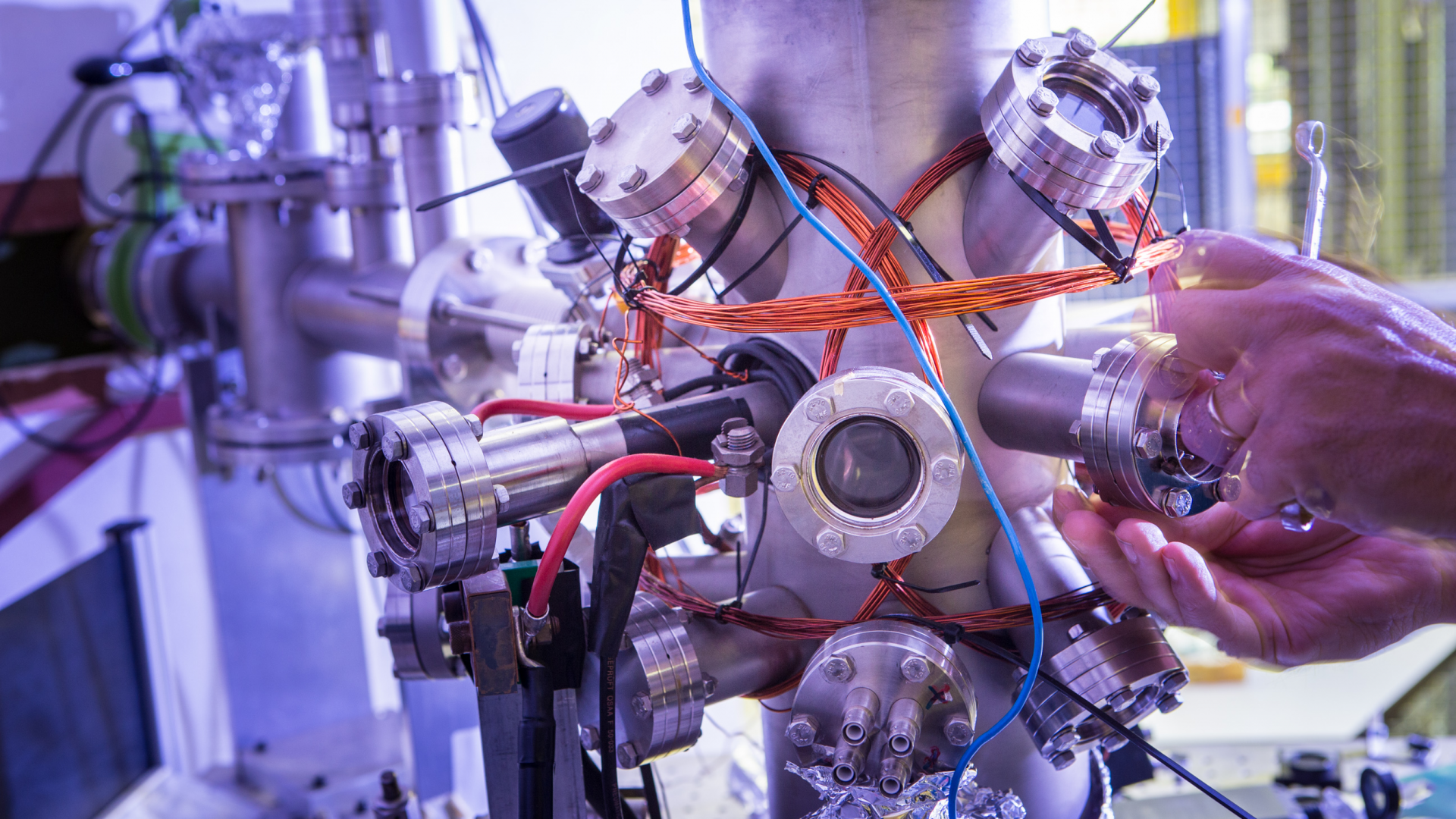
A new way to model amorphous materials
Researchers in the Materials Theory and Modeling group at ARCNL have developed software to generate models of amorphous materials and assess what those models can reliably tell us. The new software called “Vitriflow” is publicly available online. The team’s methodology is published in the journal Computational Materials Science.
Through the window glass
Amorphous materials do not have a regular, repeating structure like a crystal does. Window glass is a familiar example. Rather than melting at a single temperature, it softens progressively when heated – a behavior glassmakers exploit to shape everything from bottles to delicate ornaments.
Other types of amorphous materials are used in thin films and coatings in electronics, and the disorder within the material structure is what gives rise to essential properties for energy materials such as solar cells and rechargeable batteries. The widespread use of amorphous materials makes them central to developing advanced technologies.
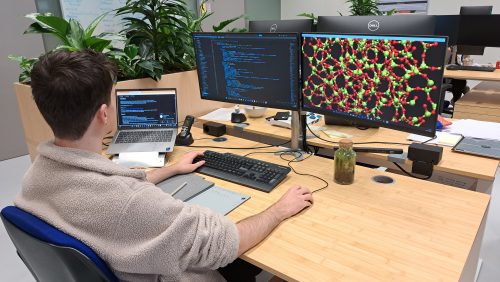
Being able to simulate such materials accurately is an important part of this development. Yet, a simulation may capture the average structure in the material while missing less common atomic arrangements that influence how the material behaves. It may be those unusual, outlying deformations within the material structure that can cause the most interesting and potentially useful properties.
Simulating amorphous materials in a way that captures this variation is a challenge, one that Dr. Jonathon Cottom, Robin Delhomme, and Dr. Emilia Olsson sought to overcome in their latest study. “Think of a study of a group of people. An average can conceal a small group whose experiences matter, and the sample needed depends on the question,” explains Emilia. “For an amorphous material, we likewise need to know which atomic arrangements were sampled, whether the feature of interest appears often enough to study, and how uncertain our estimate is.”
Melting and freezing
The approach the team took with their new software builds on an established method of simulating the process of melting a crystalline material and then quickly freezing it back to a solid again. Melting a crystal into a liquid allows the molecular structure to become more disordered – when ice melts into water, for example, it becomes able to flow and take on any shape. Cooling it back into a solid then needs to happen sufficiently quickly, otherwise the atoms have time to reorder themselves into a crystal structure again.
The software Vitriflow makes the generation and assessment of collections of structures systematic. By combining the results of this process across a range of melting and freezing times, the software can produce amorphous materials with user-input parameters and a series of internal checks. It records which structures are included in an analysis and reports uncertainty for each measured feature, such as how often an unusual arrangement occurs. Researchers can then see which conclusions their models support and where more information is needed.
This approach to modeling amorphous materials reveals properties that an average alone would hide, providing useful information for materials research and design.
Towards predictive modeling
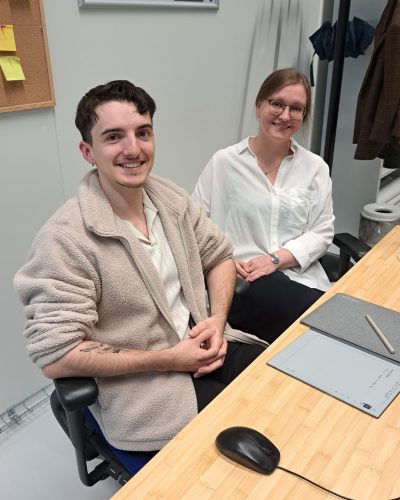
The development of this software is a crucial step towards predictive modeling of amorphous materials. “With Vitriflow, experimental materials researchers can use the models to test interpretations of their measurements.” says Robin. “Meanwhile, theorists can compare different simulation methods on a common footing.”
The work also provides a stronger basis for future machine-learning models: their training data needs to represent the atomic arrangements relevant to the behavior they are intended to predict, including uncommon ones. “This allows for more rigorous tests of how atomic structure shapes material behavior and provides better grounded data for future machine learning.” says Jon.
The research behind Vitriflow is now published in the journal Computational Materials Science. The software itself is also publicly available on Github, together with the study’s structures and analysis records. Researchers can also assess existing datasets before deciding what new simulations to run.
“What excites us is that we can now investigate disorder quantitatively, including uncertainties,” says Emilia. “Some of the most important features of a material are the ones an average hide. Our ambition is to turn those overlooked atomic details into a foundation for discovery, helping us to move from describing the materials we have towards designing the materials that we need.”
Contact
If you have questions about this research, please contact Emilia Olsson (E.Olsson@arcnl.nl).
Publication
Jonathon Cottom, Robin Delhomme, Emilia Olsson. Vitriflow: Calibrated amorphous structure ensembles from melt–quench simulations. Computational Materials Science 275, 115098 (2026). https://doi.org/10.1016/j.commatsci.2026.115098


