Metrology
Light-Matter Interaction

About
The Light-Matter Interaction group uses femtosecond lasers (light) to exploit ultrafast physics processes for a wide range of semiconductor (matter) metrology applications.
Research focus
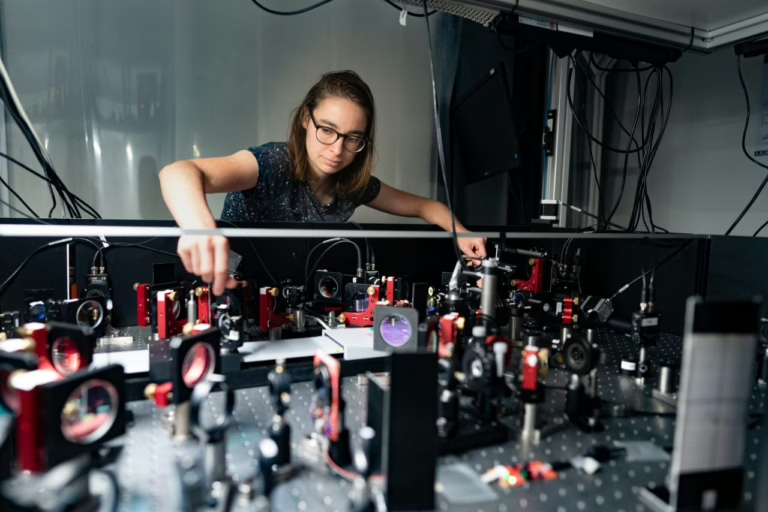
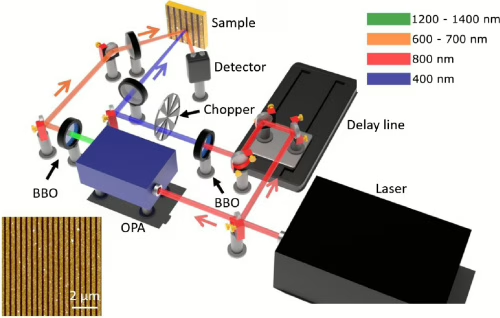
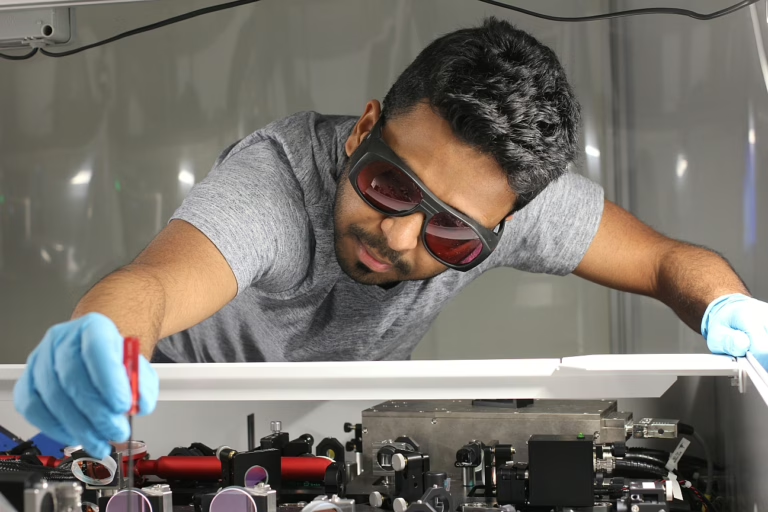
Functional metrology plays an important role in semiconductor manufacturing, allowing for the identification of defects and assessment of chip functionality. In our group, we use ultrashort laser pulses with a duration of tens of femtoseconds (~ 10-13 s) to explore new ideas for metrology applications in semiconductor device manufacturing. The topics we study vary from inducing and detecting optical damage; to exploring infrared (IR) and far-IR light pulses for non-contact measurements of (static) charge and conductivity and for quality control; to photo-acoustics, where femtosecond laser pulses are used to generate and detect ultrashort strain waves. Light-matter interaction is at the core of our activities, which are mostly fundamental in nature, but with possible applications in mind.
Ultra-short, pulsed lasers display a variety of interesting properties and unique measurement techniques, like the measurement of lattice dynamics in solids via pump-probe (photo-acoustics), optical measurement of electrical fields inside materials (Electrical field induced second harmonic generation), or even the direct measurement of the electrical field of radiation (Terahertz).
However, due to the requirement of high optical powers to measure these effects, the risk of damaging the samples or even the optics increases significantly. The project on laser damage investigates how systems like thin films or nanostructures are modified under incredibly intense radiation, how early damage can be detected, and how these modifications could be potentially mitigated. In short: we burn holes into samples and the look under microscopes at them.
Electric charge is one of the fundamental quantities in physics and is of great importance to semiconductor manufacturing. It governs the dynamics of surfaces and interfaces during layer growth, influences the accuracy of critical metrology processes, and ultimately controls the flow of information in electronic devices.
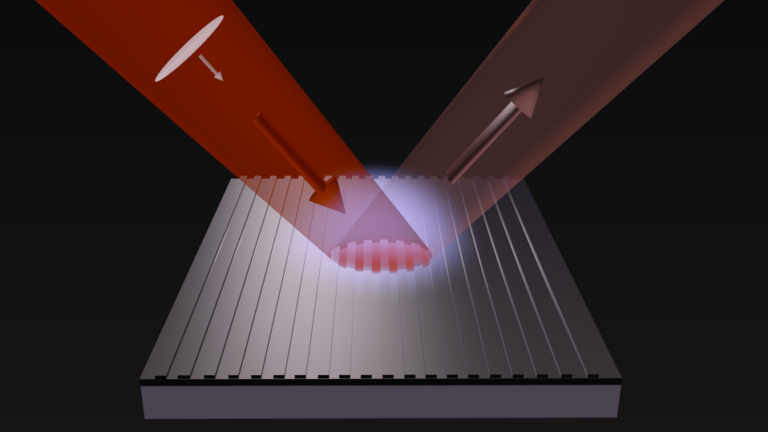
We are interested in using the detection (or lack thereof) of electric field-induced second harmonic generation (EFISH) to detect and quantify electric fields that arise from the presence of charge. Most amorphous thin films, particularly dielectrics, do not generate second harmonic light in their normal state due to their internal structure. However, electric fields will change this structure to allow second harmonic generation, which we can detect. EFISH provides a quantitative, non-contact method of measuring electric fields, and therefore charging, in-situ and in real-time.
Terahertz electromagnetic radiation has wavelengths between 30 and 3000 μm, covering a significant part of the electromagnetic spectrum. Unlike traditional spectroscopic techniques that measure only intensity, THz time-domain spectroscopy captures the full electric field waveform in time, providing both amplitude and phase information. This allows for the direct calculation of the complex refractive index, enabling the determination of detailed material properties.
However, THz wavelengths also introduce challenges. The diffraction limit constrains spatial resolution to approximately half of the wavelength, which is around 150 µm for 1 THz, too large for imaging features on the scale of semiconductor devices. Our current research focuses on the integration of near-field techniques to enable sub-wavelength spatial resolution, the investigation of 2D materials, as well as the generation of terahertz light from air plasma.
Group members
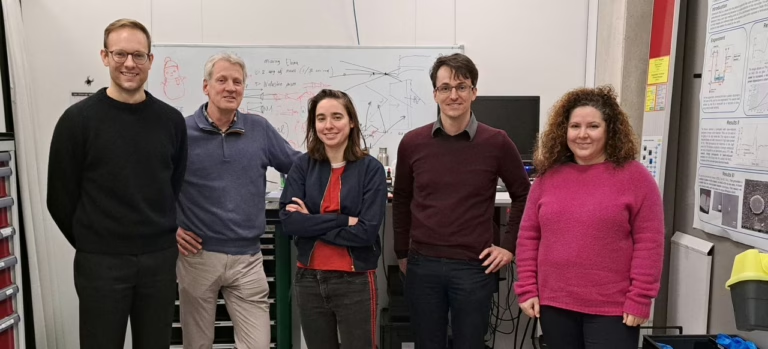
Paul Planken is the head of the Light-Matter Interaction group at ARCNL since 2014, and a Full Professor at the University of Amsterdam. His research interests lie in the areas of photo-acoustics, laser-induced damage, terahertz microscopy, and electric-field-induced second harmonic generation, all within the context of (optical) metrology.









Latest news





Most recent publications